Chairs



Do que se trata?
A Escola Latino-Americana de Informática (ELI) é uma evolução dos tutoriais que são ministrados em todos os CLEI. Desde 2022, a formalização desses tutoriais foi iniciada e, para a terceira edição a ser desenvolvida em paralelo ao CLEI 2025, o objetivo é oferecer uma variedade de cursos de interesse para estudantes de graduação, pós-graduação e profissionais. Os cursos serão propostos de forma semelhante aos trabalhos da conferência, ou seja, serão avaliados por um comitê acadêmico que selecionará um conjunto de cursos. Os tópicos previstos para o ELI envolvem todas as áreas da ciência e engenharia da computação.
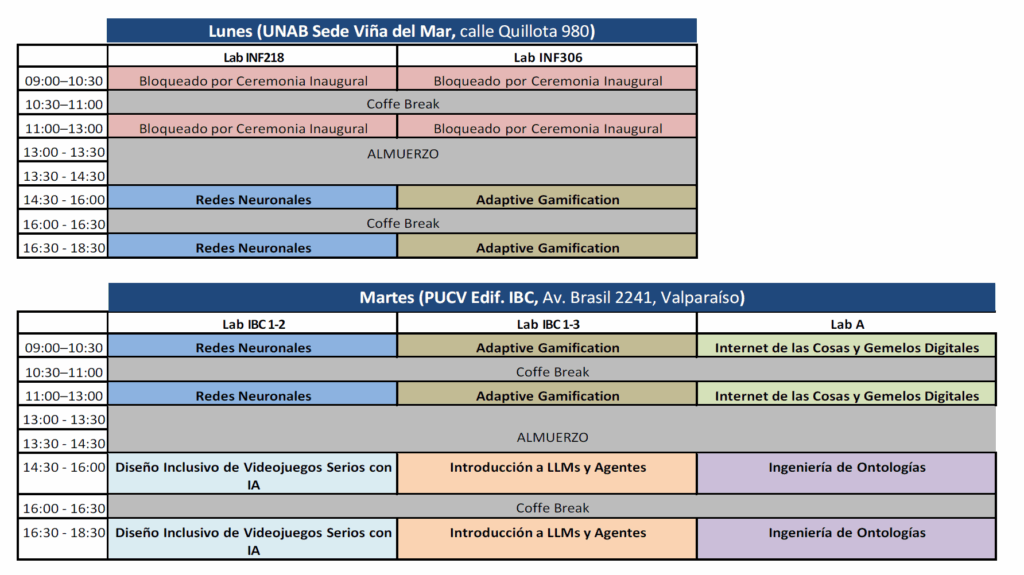
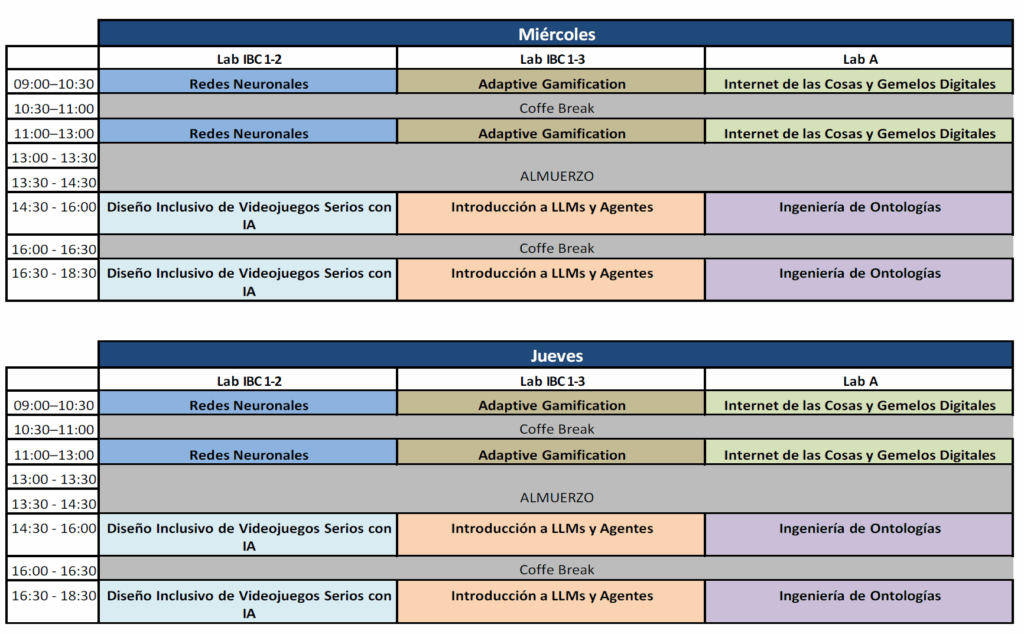
Course Schedule
Pre-Registration
There will be a pre-registration period for ELI courses until Wednesday, October 22nd. Once pre-registration closes (Wed, Oct. 22nd), selected participants will be notified via email (Thu, Oct. 23rd). After that date (Oct. 23rd), if there are any remaining spaces, they will be filled via registration on a first-come, first-served basis. Participants can register for one or two courses, ensuring they are not overlapped with the already published schedule.
All registered participants from any of the three conferences: CLEI, JCC, and Chilecon 2025 can register for ELI courses. During pre-registration, and depending on the availability of spaces for each course, preference will be given to researchers, professionals, and graduate students.
The ELI course registration form is Closed.
Courses
- Internet of Things and Digital Twins – by Dr. Rodrigo Santos (UNS – Argentina)
- Duration: 15 in-person hours
- General objective: To acquire the necessary knowledge to analyze complex IoT-based communications systems to feed digital twins that support decision-making in different application areas.
- Specific objectives:
- Understand the structure of the Internet of Things as a network of sensors/actuators.
- Know the most commonly used IoT data protocols: MQTT, COAP.
- Understand the interrelationship of data protocols and communication standards.
- Cloud computing, edge computing, application and data synchronization.
- Know how digital models and system evaluation are created.
- Adaptive gamification for collaborative projects – led by Dr. Diego Torres (UNLP, Argentina) and Dr. María Dalponte Ayastuy (UNQ, Argentina)
- Duration: 15 in-person hours
- General objective: To present an introduction to the concepts of gamification and adaptive gamification, the state-of-the-art in adaptive gamification strategies for collaborative projects, and a description of adaptive gamification design patterns.
- Specific objectives:
- To understand the characteristics of collaborative projects, in terms of the tasks to be gamified, including spatial and temporal elements.
- To understand different classic models of gamification and adaptive gamification.
- To be able to select and design different approaches to adapting gamification in collaborative projects.
- To understand qualitative and quantitative evaluation approaches and be able to design an evaluation in a specific collaborative context or project.
- Introduction to LLMs and Agents: Architectures and Applications in Software Engineering – by Dr. J. Andrés Díaz Pace (UNICEN – Argentina)
- Duration: 15 in-person hours + 15 additional practical hours
- Objectives: This course offers an introductory overview of LLMs and their applications, from prompting-based conversational chatbots to Retrieval-Augmented Aggregate (RAG) techniques to agents. The course presents the main concepts for building intelligent applications using different patterns involving LLMs, with an emphasis on agent design and evaluation, analyzing methodologies and challenges for both research and production environments. Frameworks such as Langchain, LlamaIndex, and AutoGen will be used to illustrate the concepts with practical exercises. Additionally, the course aims to provide applications in the field of Software Engineering (e.g., design decisions, architecture evaluation, requirements generation).
- Neural Networks for Text Analysis and Generation – by Dr. Aiala Rosá (UDELAR – Uruguay), Dr. Guillermo Moncecchi (UDELAR – Uruguay), and MSc. Juan José Prada (UDELAR – Uruguay)
- Duration: 15 hours of classroom time + 15 hours of final project
- Objective: The objective of this course is to present methods based on deep neural networks, applied to the field of Natural Language Processing, particularly text analysis and generation. The main neural network architectures currently in use are presented, with special emphasis on the Transformer architecture and language models based on it, and their application to various text analysis and generation tasks.
Inclusive Design of Serious Video Games with Generative Artificial Intelligence – by Dr. Ismar Frango Silveira (UPM – Brazil) and Dr. Valéria Farinazzo Martins (UPM-Brasil)- Duration: 15 in-person hours + 10 hours of final project
- Objectives:
- Understand the fundamental concepts of serious video games, accessibility, and generative artificial intelligence
- Identify the benefits and applications of serious video games in various sectors
- Explore generative AI techniques for creating and managing serious video games
- Learn to develop and implement serious video game use cases with generative AI
- Analyze practical examples of accessible serious video games with generative AI
- Ontology Engineering – led by Dr. Regina Motz (UDELAR – Uruguay) and Dr. Edelweis Rohrer (UDELAR – Uruguay)
- Duration: 15 in-person hours + 10 hours of final project
- Objectives:
- This course is designed to provide graduate and professional students with rigorous training in the development and application of computational ontologies as formal knowledge representation systems.
- The pedagogical approach combines theoretical sessions on formal foundations with practical workshops. This combination allows participants not only to understand abstract principles but also to apply this knowledge in the development of concrete solutions. The analysis of selected case studies provides context and relevance to the concepts learned.
- Upon completion of the program, participants will have developed key competencies to design formally rigorous ontologies, evaluate existing models with academic criteria, and implement ontology-based solutions that address specific research challenges.
Chamada para propostas de cursos
O ELI 2025 convida à apresentação de cursos em qualquer área da ciência e engenharia da computação e suas tecnologias e fundamentos teóricos relacionados, apresentando tópicos atuais baseados em resultados de pesquisa, o estado da arte de um determinado tópico ou a introdução a um tópico de interesse industrial ou acadêmico, considerando os tópicos incluídos nas trilhas do CLEI: Sistemas de Software, Sistemas Inteligentes, Sistemas na Prática, Tecnologias em Computação e Educação em Computação.
Serão aceitos dois tipos de propostas de cursos para a semana da conferência CLEI:
- Cursos com 15 horas de ensino presencial pelo professor e um mínimo de 25 horas de tempo total do curso, acrescentando às horas presenciais as horas extras necessárias de trabalho final a ser realizado pelo aluno após o término da escola, como (parte da) avaliação, a ser coordenada durante a escola com os alunos, os coordenadores e a organização local.
- Cursos de 10 a 15 horas de ensino presencial pelo professor, sem horas extras, que concederão apenas certificados de participação do ELI-CLEI.
Será oferecido apoio parcial para participar do ELI para ministrar cursos presenciais durante o CLEI 2025. Isso será coordenado com os proponentes assim que os cursos selecionados forem notificados.
ENVIO DE PROPOSTAS DE CURSOS
A proposta de curso deve ser enviada em formato PDF via easychair, indicando a trilha do ELI, incluindo as seguintes informações:
- Título do curso
- Área de computação a que pertence (simpósio associado)
- Conteúdo (resumo geral e agenda detalhada)
- Duração (número total de horas de aula e número proposto de dias/horas por dia)
- Capacidade do curso (se disponível)
- Currículo do(s) palestrante(s)
- Idioma da apresentação (inglês, português ou espanhol)
DATAS IMPORTANTES
- Prazo de envio:
01/06/202515/06/2025 (Estendido) - Notificação aos autores: 30/06/2025
- Versão final: 20/07/2025
REVISÃO DAS PROPOSTAS
As propostas de cursos serão avaliadas por um comitê acadêmico que selecionará um conjunto de cursos, com base no cumprimento dos requisitos definidos nesta chamada, incluindo o currículo do(s) proponente(s). O ideal é que os tópicos dos cursos pertençam a 3 áreas diferentes da disciplina de Ciência da Computação, variando em relação à edição imediatamente anterior da Escola e em alinhamento com os interesses da organização local.